
The Shadow Effect in Tourism
Why do extraordinary destinations stay invisible, and how do they win strategic independence? What the shadow effect is and why…
Why do extraordinary destinations stay invisible, and how do they win strategic independence?
What is the shadow effect and why is it structural in tourism?
Tourism is a deeply symbolic industry. Before it is physical travel, it is the construction of meaning. The traveler does not simply buy a landscape, a place to stay or an itinerary; they buy a narrative about identity, desire and social perception. In this environment of symbolic dispute in tourism, only a few destinations manage to occupy central positions in the collective imagination. When that happens, these places stop being merely geographic territories and start functioning as consolidated brands in tourism.
The phenomenon of symbolic concentration in the tourism market is widely observed in the global travel landscape. According to data from the World Tourism Organization, a small fraction of the world’s destinations concentrates most international flows, reproducing a pattern of high concentration of visibility, investment and brand authority. This movement repeats itself inside countries as well. In Brazil, cities like Gramado, Bonito and Salvador not only receive large volumes of visitors, but have become regional symbolic references, representing, for many travelers, an entire tourism region.
The shadow effect in tourism is born precisely in this context. It occurs when equally relevant destinations, culturally rich and endowed with competitive attractions, come to exist only as a narrative extension of a dominant destination. They are not chosen for themselves. They are chosen “because they are nearby.” They do not appear as the main answer in Google searches or in digital recommendations. They appear as a complement. This is the central point of the loss of prominence.
It is important to clarify that “shadow effect in tourism” is not a technical term formally consolidated in the international academic literature, but rather a strategic conceptual construction that synthesizes phenomena already widely studied under other names. In the scientific production on tourism and territorial marketing, similar dynamics appear associated with concepts such as destination overshadowing, the core-periphery model, brand dominance in regional tourism, the spillover effect and destination image concentration. These terms describe, from different theoretical perspectives, the concentration of visibility, symbolic capital and tourist flow in a dominant hub, while neighboring localities remain with a diluted or subordinate identity. Therefore, although “shadow effect” is not a formal standardized concept, it speaks directly to these international references and can be understood as an applied synthesis of brand concentration dynamics in contemporary tourism planning.
Shadow is not an absence of value. It is an absence of prominence. In a digital landscape dominated by search engines, recommendation algorithms and generative artificial intelligence, this difference is critical. A destination that does not respond as the protagonist to the traveler’s core questions can hardly win digital authority in tourism. And digital authority is, today, an indispensable condition for building and consolidating a territorial brand.
The main types of shadow effect in tourism
The shadow effect is not homogeneous. It takes on distinct forms depending on regional structure, economic dynamics and brand-building history. Understanding its typology is essential to formulating effective strategy. The main types of Shadow Effect in Tourism are: Territorial, Cultural or Historical, Internal, Consolidated Brand and Gateway.
Territorial Shadow
The territorial shadow occurs when the region’s brand becomes stronger than the identity of the municipalities that make it up, absorbing their visibility and diluting their symbolic autonomy. In this scenario, the territory becomes the protagonist and the cities start functioning as backstage. The tourist says “I am going to Jalapão,” but rarely mentions Mateiros, even though it is the municipality that concentrates a significant part of the fervedouros, dunes and most emblematic experiences of the region. Recognition concentrates in the macro name, while the municipality remains with low spontaneous recall and little authority of its own in digital searches.
This type of shadow presents a specific strategic challenge: the destination is not competing with another municipality, but with the consolidated territorial brand itself. The problem is not a lack of attractions, but the absence of a direct association between the municipality’s name and the experiences that generate desire. When the traveler searches for “fervedouros in Jalapão,” if the municipality’s name does not appear consistently as a central reference, it stays invisible within its own region.
The strategic way out is not to break with the territorial brand, but to reposition the municipality as the experiential core of the territory. This means structuring communication, digital content and positioning so that the municipality’s name is directly linked to the region’s main experiences. In practical terms, it is turning the municipality into the symbolic capital, operational base or epicenter of the most sought-after experiences. This move strengthens local identity without weakening the strength of the regional brand.
A consistent international example is Queenstown, in New Zealand. For a long time, it was perceived merely as a point within the South Island. By strategically taking on the positioning of world capital of adventure sports, it consolidated itself as a global reference in bungee jumping, extreme sports and active tourism. Instead of competing with the brand of the South Island as a whole, Queenstown occupied a specific territory within it and came to be directly associated with the experience the traveler wanted to live. In doing so, it won symbolic independence within a broader territorial context, proving that emerging from the territorial shadow depends on clear specialization and an unequivocal association between place and experience.
Cultural or Historical Shadow
The cultural shadow is especially common in regions where there is a concentration of historic cities nearby, competing symbolically for the same heritage imagination. In these contexts, one locality ends up becoming the dominant icon of collective memory, absorbing national and international recognition. This is what happened with Ouro Preto, which consolidated itself as the supreme symbol of Brazilian Baroque and national historic heritage, becoming an almost automatic reference when it comes to colonial Minas Gerais. Meanwhile Mariana, equally rich in churches, museums, religious traditions and cultural expressions, remained in the background for decades, often perceived only as an extension of the main itinerary.
The challenge of the cultural shadow is deep because it involves a dispute over symbolic legitimacy, not just tourist flow. When two cities share a similar historic matrix, trying to compete for the same generic title of “historic city” tends to reinforce the hierarchy already established. The leading destination occupies the space of collective memory, while the other becomes a narrative supporting act.
The strategic way out, therefore, is not to claim the same attribute, but to deepen cultural layers not yet saturated by the leader. In Mariana’s case, this means investing in the appreciation of immersive experiences, structured religious tourism, original cultural festivals and the strengthening of living heritage, highlighting not only the architecture but the cultural practices, musical traditions, celebrations and the preserved historic everyday life. By shifting the focus from monumentality to experience, the destination builds an identity of its own within the same historic territory.
Destinations that manage to emerge from the cultural shadow usually do so by taking on clear and specific narrative angles, becoming a reference within a well-defined cultural niche. Tiradentes is an emblematic example. Part of the historic Minas Gerais circuit, it stopped generically disputing the label of “colonial city” and consolidated itself as a gastronomic and boutique destination, associating its image with culinary festivals, sophisticated experiences and charming hospitality. By taking on that specific territory within the historic universe, Tiradentes won symbolic prominence of its own, ceasing to be merely part of a larger itinerary to become the main reason for the trip.
Internal Shadow
The internal shadow occurs when a neighborhood, district or beach becomes stronger as a brand than the municipality it belongs to, concentrating recognition, flow and spontaneous recall in a single point of the territory. In this scenario, municipal identity fragments and the collective imagination starts associating the entire experience with a specific part of the destination. This is what happens when Pipa is widely remembered as a tourist destination, while Tibau do Sul, the administrative municipality it belongs to, remains with low visibility and little direct association in searches and travel narratives.
The impact of this dynamic goes beyond perception. It influences the distribution of flow, revenue, investment and territorial brand-building. When the entire narrative concentrates in a micro-territory, other areas of the municipality tend to receive less promotional attention, less strategic development and lower symbolic recognition. The result is a structural imbalance: the destination grows in a concentrated way, while the rest of the territory remains underused.
Overcoming the internal shadow demands integrated governance and a territorial brand strategy articulated at multiple levels. It is not about weakening the dominant neighborhood or district, but about connecting its strength to the broader municipal identity, expanding the narrative repertoire. This implies structuring communication that presents the micro-territory as part of a larger ecosystem, reinforcing that the experience is not limited to a single point. By strategically integrating macro and micro-territorial identity, the destination reduces the excessive concentration of visibility and strengthens the municipal brand as a whole, promoting more balanced and sustainable growth.
Consolidated Brand Shadow
The consolidated brand shadow occurs when a destination builds branding so strong that it starts monopolizing the symbolic attributes of an entire region, concentrating spontaneous recall, digital searches, media coverage and purchase decisions. In this scenario, the territory stops being perceived as diverse and starts being represented by a single name. The dominant brand becomes synonymous with the regional experience, absorbing symbolic capital and authority.
In Brazil, the best-known example is the relationship between Gramado and Canela, in the Serra Gaúcha. Gramado consolidated itself as a national reference in themed tourism, romance and major events, investing for decades in urban scenography, festivals and the construction of a European atmosphere. With millions of visitors a year and a constant presence in promotional campaigns, it became synonymous with the region. Canela, despite having emblematic natural attractions such as Parque do Caracol and areas of preserved forest, frequently appears as the “neighboring city.” The collective imagination automatically associates the Serra Gaúcha with Gramado, while Canela emerges as an itinerary complement.
This pattern, however, is not exclusive to the south of the country. In Mato Grosso do Sul, the state where this content was produced, the relationship between Bonito and Bodoquena illustrates the dynamic of the consolidated brand shadow even more clearly. Bonito built an international reputation as an organized ecotourism destination, with snorkeling in crystal-clear rivers, rigorous environmental control and a professionalized structure, consolidating itself as one of Brazil’s main nature hubs. The Bonito brand became so strong that, for many travelers, it represents the entire ecotourism experience in the region.
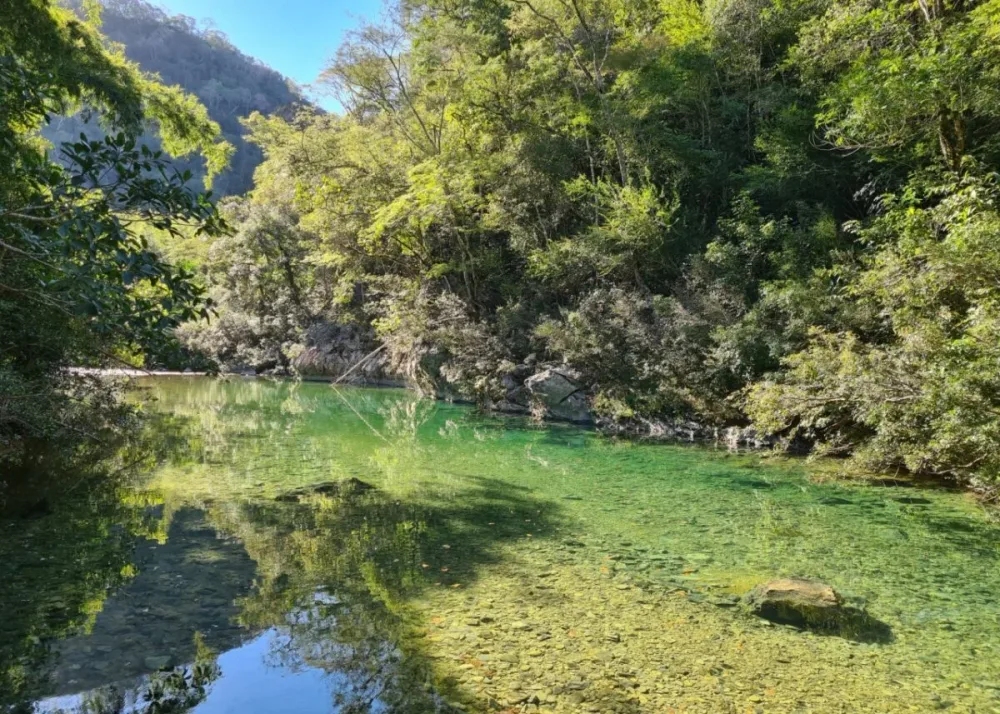
Bodoquena, in turn, located in the same geographic area and part of the context of the Serra da Bodoquena, concentrates exuberant waterfalls, trails through preserved forest and adventure experiences with a more rustic and authentic atmosphere. Even so, for years, it was perceived only as an extension of the main itinerary. The recurring question was not “why go to Bodoquena?” but “what is there to do near Bonito?”
This article, in fact, is born of an insight lived in the territory itself. This content was produced at Eco Serrana Park, in Bodoquena, where the strength of the landscape, the authenticity of the experience and the still underexplored potential for strategic positioning made the opportunity for narrative transformation evident. There, the perception became clear: Bodoquena does not need to be the “other Bonito.” It needs to embrace with conviction what sets it apart.
The most common strategic mistake in scenarios like this is trying to compete for the same symbolic territory. If the shadow destination tries to replicate the regional leader’s model, it reinforces the hierarchical comparison. The traveler, faced with the choice between original and replica, tends to opt for the original.
The way out lies in conscious strategic differentiation. If Bonito represents organized ecotourism, structured snorkeling and a controlled experience, Bodoquena can take on wilder nature, intense adventure, challenging trails and a less mediated atmosphere, turning its rusticity into a value attribute. It is not about rivalry. It is about occupying distinct symbolic territories within the same region.
In the same way that Canela can position itself through nature in the face of Gramado’s scenography, Bodoquena can turn its authenticity into a competitive advantage in the face of Bonito’s consolidation. When this differentiation is structured with strategic clarity, product coherence and aligned digital presence, the shadow stops being a limitation and becomes a contrast.
And contrast, when worked well, is positioning.
Gateway Shadow
The gateway shadow occurs when the city that concentrates the airport, robust logistical infrastructure or political capital status starts absorbing disproportionate visibility, symbolically eclipsing the destinations around it. In this scenario, the hub not only organizes the physical flow of visitors but also monopolizes the region’s tourist imagination. Air connectivity, the presence of large hotel chains, press coverage and institutional strength continually reinforce its centrality. The result is that nearby localities, even if they have an identity of their own and competitive attractions, are perceived only as extensions of the stay in the main hub.
In the Brazilian Northeast, Salvador clearly exemplifies this dynamic. As a historic and cultural capital and the main air hub of Bahia, the city concentrates a large part of the state’s tourist flow, plus wide media exposure and international recognition. The symbolic strength of the Pelourinho, Carnival and the Farol da Barra turns Salvador into an automatic reference when one thinks of Bahian tourism. In this context, destinations like Praia do Forte, despite their proposal tied to sustainable tourism, the charming village and the Tamar Project, were for a long time perceived as an itinerary complement, something to be visited “after arriving in Salvador.”
Overcoming the gateway shadow demands a structural change in the logic of positioning. The secondary destination needs to stop being seen as an extension and start being understood as the main reason for the trip. This implies redefining the narrative, structuring a coherent product and strengthening its own digital presence, so that the destination’s name appears as a direct answer to the traveler’s search intentions.
The international case of Tulum and Cancún, in Mexico, is emblematic. Cancún consolidated itself as the major hub of the Mexican Caribbean, receiving millions of tourists drawn by all-inclusive resorts and large-scale infrastructure. For decades, Tulum was perceived as a complementary stop. The transformation occurred when Tulum decided not to compete for the same audience nor for the same attribute. Instead of disputing mass tourism, it took on an identity centered on sustainability, architecture integrated with nature, spirituality and a boutique atmosphere. By occupying a distinct symbolic territory within the same region, Tulum won narrative autonomy and became a destination desired in its own right, not merely an extension of the hub.
The central strategic insight is clear: geographic proximity cannot mean permanent narrative dependence. The gateway can be a logistical entry point, but it should not become a symbolic anchor. Destinations that understand this difference manage to turn the hub’s strength into an opportunity for access, while at the same time building an identity of their own, consolidating themselves as an intentional choice and not merely a consequence of arrival.
Why do destinations remain in the shadow?
Destinations remain in the shadow due to a combination of structural, strategic and narrative factors that reinforce one another over time. The first of them is the absence of clear and intentional positioning. Many municipalities invest resources in broad and generic promotion, highlighting isolated attractions without defining which symbolic territory they want to occupy in the traveler’s mind. When there is no well-defined value proposition, the destination starts existing only as a natural extension of the regional leader. By trying to replicate the neighbor’s success model, whether in events, aesthetics, discourse or infrastructure, it ends up reinforcing the hierarchy already established. The market tends to choose the destination that consolidated authority first, not the one that tries to imitate it.
Another determining factor is the fragility of strategic digital presence. Today, tourism authority is built in large part in search engines and in the answers generated by artificial intelligence. If the destination appears predominantly in searches associated with the regional leader, the algorithms themselves consolidate this relationship of dependence. In the context of SEO, which involves being found in organic searches, and of GEO, which concerns presence in the answers of AI systems, authority depends on the ability to respond directly to the user’s core questions. If the question is “what is the best adventure destination in the region?” and only the dominant destination emerges as a structured answer, the shadow perpetuates itself in the digital environment. Invisibility is not only symbolic, it becomes algorithmic.
There is also a frequent misalignment between discourse and product. Communication, on its own, does not transform positioning. It is not enough to state that the destination is different, it is necessary to materialize that difference in concrete experiences, qualified services and infrastructure coherent with the chosen narrative. If the municipality communicates adventure but does not offer marked trails, trained guides or a minimum safety structure, the promise loses credibility. If it promotes wellness but has no real offer of integrated experiences, the narrative empties out. The shadow, in this context, is not only the result of the neighbor’s strength, but a consequence of internal inconsistency. Overcoming it demands strategic coherence among identity, product and digital presence, consolidating real and sustainable authority.
Trends and opportunities
The opportunity for “shadow” destinations has never been so clear because demand for alternatives to hotspots has become measurable behavior, not just intuition. In the Unpack ‘25 (2024) report, Expedia Group draws attention to the “Detour Destinations,” lesser-known and less crowded destinations that function as a “smart detour” from major hubs, and records a direct figure: 63% of consumers say they will likely visit a detour destination on their next trip. Along the same lines, the global Booking.com (2025) survey on the impact of tourism on communities shows that the theme of “avoiding crowds” has entered the traveler’s agenda with strong numbers: 36% say they consider visiting alternative destinations to avoid overcrowding, while 39% say they seek recommendations to travel at other times of the year as a way of reducing pressure on busy destinations. This creates a strategic shortcut for Canela, Bodoquena, Mariana, Praia do Forte and so many others: instead of trying to beat the dominant destination in the “same championship,” they can position themselves as the smart choice for those who want the same region with a different logic, calmer, more authentic and more personalized. And the second avenue of growth is even more valuable because it tends to generate longer stays, higher ticket sizes and a narrative of its own: niches, especially wellness. The Global Wellness Institute points out that global spending on wellness tourism reached US$894 billion in 2024, reinforcing the size of the market for experiences tied to integral health, reconnection with nature, intentional rest and regenerative practices. When you put these signals together, the game changes: destinations in the shadow have a real chance of becoming protagonists if they take on a clear and provable value angle, such as a wellness refuge, a base for trails and adventure, origin-based gastronomy, regenerative tourism or community experiences, and structure this to appear as a direct answer to the questions travelers ask on Google and in AI, of the kind “where to go to avoid crowded places?”, “alternative destinations near X”, “wellness trip in Brazil” and “nature refuge to rest.”
How to organize the destination to emerge from the shadow
Emerging from the shadow is not the result of an isolated campaign, nor of a one-off promotional action. It demands multidimensional strategic organization, which articulates diagnosis, positioning, product, communication and governance in an integrated way. Destinations that win symbolic independence do not do so by chance. They structure a conscious process of repositioning and consolidation of authority.
The first step is to carry out a deep diagnosis of perception and digital presence. Before defining any strategy, it is indispensable to understand how the destination is perceived by the market and how it appears in the online environment. This involves mapping how the municipality’s name shows up in organic searches, which keywords associate it with the regional leader and whether it appears as a protagonist or merely as a complement. It is also fundamental to analyze how the destination is cited by artificial intelligence assistants, since systems based on language models prioritize sources with consolidated thematic authority. Search analysis tools, mention monitoring, content audits and competitive assessment make it possible to identify positioning gaps and strategic opportunities. Without this diagnosis, any action tends to be intuitive and not very effective.
The second step is to define a clear and distinctive symbolic territory. This stage requires answering with precision the central question: what unique transformation does this destination offer the traveler? It is not about listing attractions, but about structuring an unequivocal value proposition that differentiates the destination from the regional leader. If the dominant hub occupies the imagination of romance, perhaps the shadow destination can take on adventure. If the leader represents structured and organized tourism, perhaps the other can take on authenticity and immersion. The definition of this territory needs to be specific, strategic and coherent with the local reality. Generalities keep the destination invisible.
The third step is to align product with narrative. Differentiation only holds when it is tangible. If the destination chooses to position itself as a reference in adventure, it must invest in well-marked trails, guide training, safety protocols and infrastructure compatible with that promise. If it takes on wellness as its central axis, it needs to structure real experiences of reconnection, integrative practices and appropriate environments. The misalignment between discourse and delivery compromises credibility and reinforces the shadow. The narrative needs to be sustained by concrete evidence.
The fourth step is to build independent social proof and authority of its own. Original events, themed festivals, institutional recognition, participation in awards, presence in specialized media and partnerships with segmented influencers help consolidate legitimacy. When the destination starts generating its own news and not just appearing linked to the regional leader, the construction of symbolic independence begins. Social proof functions as external validation of strategic positioning.
Organizing the destination to emerge from the shadow is, therefore, a structured process that involves clarity, coherence and constancy. It is not about competing for the same space, but about occupying a space of one’s own with conviction and strategy.
The strategic importance of the Tourism Marketing Plan
The tourism marketing plan is much more than an institutional document or an administrative formality. It is the strategic instrument that organizes vision, positioning, narrative and execution in a structured way, connecting territorial identity to concrete results. In shadow-effect contexts, the plan stops being optional and becomes essential, because it is what defines how the destination will build prominence and consolidate authority of its own.
A well-structured plan should start with an in-depth competitive analysis, mapping not only direct competitors but also the dominant destination that casts a shadow over the region. It is necessary to understand which attributes this leader occupies, which audience it attracts, which narratives it reinforces and how it positions itself digitally. Without this strategic reading, the destination runs the risk of competing for the same symbolic territory and reinforcing the existing hierarchy.
Next, the plan needs to establish a clear definition of a priority audience, avoiding generic communication. Destinations that try to speak to everyone end up being relevant to no one. By segmenting strategic audiences and niches, such as adventure, wellness, gastronomy or immersive cultural tourism, the municipality manages to build a more targeted and effective proposal.
Another central element is the distinctive value proposition, which must objectively answer the question: why choose this destination and not the better-known neighbor? This proposition needs to be sustained by evidence, real experiences and concrete differentiation.
The plan should also include a structured schedule of promotional, institutional and digital actions, ensuring continuity and consistency in communication. Intermittency weakens authority, while constancy consolidates presence.
In the contemporary environment, it is indispensable to incorporate an integrated digital strategy oriented toward SEO and GEO. This means structuring content that allows the destination to be found in organic searches, to appear as a direct answer in artificial intelligence assistants and to build thematic authority in language models. The destination needs to answer the traveler’s core questions with clarity and depth, occupying space in the search intentions that define the travel decision.
Without structured planning, communication tends to be reactive, fragmented and dispersed, depending on one-off opportunities or seasonality. With strategic planning, the destination builds progressive, coherent and sustainable authority, reducing dependence on the regional leader and strengthening its own identity. In shadow-effect scenarios, the marketing plan is not just a promotional tool. It is an instrument of strategic emancipation.
And you already know, if you need help building the marketing plan for your destination, tourism region or business, just reach out to me!
A strategic opportunity for travel agents: turning shadow destinations into a sales argument
For the travel agent, understanding and structuring an intelligent strategy involving destinations that live under the shadow effect can become a powerful competitive advantage. Instead of selling only the most obvious and saturated destination, the professional starts offering strategic alternatives aligned with the main trends of contemporary tourism, such as the search for fewer crowds, authentic experiences, wellness niches, regenerative tourism and more personalized experiences. This not only broadens the sales repertoire but positions the agent as a strategic and up-to-date consultant, capable of suggesting tailor-made solutions for the client’s profile. By presenting a shadow destination as an intentional and differentiated choice, the agent adds value, reduces comparison by price and strengthens their professional authority. In a market increasingly oriented toward personalization and curation, selling alternative destinations stops being a plan B and becomes an intelligent sales argument and proof of alignment with global travel trends.
How to differentiate without competing on equal terms
Effective differentiation is not about the volume of investment, the grandeur of campaigns or the attempt to outdo the dominant destination in scale. It is about the strategic clarity of positioning. Destinations that manage to emerge from the shadow rarely do so because they invested more money. They do it because they chose with precision the symbolic territory they want to occupy and sustained that choice with coherence.
Competing on equal terms almost always means reinforcing the existing hierarchy. When a shadow destination tries to dispute the same central attribute as the regional leader, whether romance, organized ecotourism, major events or mass infrastructure, it enters a comparative game in which the other already has a historic advantage, consolidated recognition and digital authority built over time. The traveler, faced with two similar offers, tends to choose the one that already carries an established reputation.
Strategic differentiation begins with a simple and profound question: in which attribute is there not yet regional saturation? Instead of disputing the same audience for the same reason, the destination can take on a specific angle and deepen it. This means working well-defined niches, such as wellness, regenerative tourism, original gastronomy, technical adventure, living culture or community experiences. In doing so, the destination stops competing for volume and starts competing for meaning.
Destinations that emerge from the shadow usually build coherent and specialized narratives. They do not try to be everything to everyone. They choose to be a reference in something specific. This specialization generates clarity in communication, facilitates digital ranking, strengthens thematic authority and increases spontaneous recognition. When the traveler starts automatically associating that place with a specific experience, differentiation stops being discourse and becomes identity.
It is not necessary to be bigger. It is necessary to be clearer. Clarity reduces competitive noise, strengthens positioning and turns geographic proximity into a strategic advantage. Destinations that understand this stop disputing the same space and start occupying a space of their own, defined, recognizable and sustainable in the long term.
Where to stay updated and find strategic opportunities to emerge from the shadow
One of the most effective ways to turn destinations that live under the shadow effect into protagonists is to closely follow the main trends in tourism, innovation and strategic positioning, and the best environment for that is the sector’s specialized events. It is at these gatherings that public managers, entrepreneurs, travel agents and destination leaders gain access to updated data, real cases, global trends and discussions on traveler behavior, territorial marketing, artificial intelligence and competitive differentiation. Taking part in these spaces broadens repertoire, strengthens networking and makes it possible to see opportunities that often do not appear in day-to-day operations. A special recommendation is Turismall, which takes place from March 12 to 14, at the Museu do Amanhã, in Rio de Janeiro/RJ, bringing together specialists, destinations, technology and strategy in an environment focused on the future of tourism. For destinations that want to emerge from the shadow and for professionals who want to position themselves ahead of the market, this is a concrete opportunity for updating and connection. Registration is free and can be done here!
Final reflection: when the shadow becomes an advantage
Destinations that live in the shadow carry a strategic advantage that often goes unnoticed: they already are part of the regional imagination, even if in a secondary way. They are already on the routes, already receive visitors, already appear in searches associated with the dominant destination and already spark curiosity. Unlike totally unknown territories, they do not need to create relevance from scratch. They need to reorganize meaning.
The turnaround happens when the destination stops accepting the role of complement and takes on the position of deliberate choice. As long as communication is based on “near,” “neighbor of” or “alternative to,” the hierarchy remains intact. The strategic shift occurs when the destination starts answering with clarity the traveler’s essential question: why choose this place and not just the more famous destination next door? This change requires intentional positioning, coherence between discourse and delivery, and a digital presence structured to appear as the main answer in searches and in artificial intelligence.
The shadow stops being an obstacle when the territory takes on an identity of its own and turns proximity into competitive contrast. By consolidating a consistent narrative, thematic authority and a distinctive value proposition, the destination starts occupying a clear space in the traveler’s mind. It does not dispute the same attribute as the regional leader. It defines its own.
In contemporary tourism, prominence is not just a matter of infrastructure or promotional budget. It is above all a matter of meaning and strategy. The destination that understands this builds progressive recognition, strengthens its territorial brand and reduces symbolic dependence. The shadow, in this context, stops being a limitation and becomes a reference point for comparison that highlights differentiation.
If you see this scenario in your municipality, in your tourism region or in your business, perhaps it is time to structure this turnaround with method and clarity. Strategic planning turns potential into positioning. If it makes sense for you, we can build together a solid tourism marketing plan, guided by data, differentiation and strategic digital presence, capable of turning shadow into prominence.